Monday, 13 February 2017

Chemical History of a Candle: bonus experiment

We are reading Michael Faraday's Six Lectures for the chemistry component of a Year 9 science class. As you can surmise from the title of the book, there is a lot of candle burning going on.


The experiments involve close observation of the flame and usually involves its going out in different situations using up many matches in the process of relighting the candle often.  One student casually wondered how matches work so I assigned that question as homework.

When we reconvened the following week, the students' narrations then led to wondering if all matches were the same? So we decided to find out and set up an experiment using different kinds of matches.


Surprisingly, I had 8 different types of matches on hand: ones with turquoise match heads, black, white or pink match heads, red with white tips of various sizes and matches with cardboard sticks from souvenir matchbooks.  We used the same igniter for each strike to keep that consistent.


The students decided what they could observe that might distinguish matches from each other: What does it smell like when it first burns? or when it is first put out? What colour is the flame and the smoke? How big is the flame?

One thing usually leads to another and investigations usually lead to more questions.  They wondered if the different colours were just a dye on top of the usually red phosphorus match head or its true colour.  They first put it under a microscope to examine the match head and then started scraping off layers of the colour to see how it was constructed.

Monday, 10 October 2016

Backyard Nature Study - Ants


I'd like to suggest a very close-to-home nature study you can do whether you are in an urban setting with lots of concrete about, or not enough energy or time to give up the afternoon for a road trip to a nature area or trail, or interested in a longer study of live creatures right in your home.

It's the ant farm. Ants are readily available and if you insist that there are none around, empty a bit of sugar onto your counter and you will be rewarded with a slew of them.  A less intrusive idea would be to leave a sticky mess of candy outside and check it in a day or so.


I went to the dollar store and purchased a glass spaghetti jar and a plastic water bottle.  Anything that fits inside one of the other leaving a narrow gap between them will work. Have your children find some dirt and fill up that gap.


We punched holes in the lid with a hammer and nail. The problem was that the holes were large enough for ants to pass through.  Not good.  We closed them again with tape and made smaller holes.  The best idea is to capture large ants!


Go out and find those ants. The easiest idea is to find an ant hill, dig deep around it then have everyone scoop like crazy with soup spoons. Ants scatter quickly! Make sure you get ants and eggs.  The jackpot would be to have found a queen ant. You can also look under rocks and patio stones.


Once your ant farm has been filled dirt, eggs and ants, make a heavy paper cover to put around the outside of it to give those ants the underground feeling.  Add a sweet snack for them and a cotton ball soaked in water for their drink.


You can slide off the paper sleeve for a bit every day to see what the ants have been up to.  


In their nature notebooks, have your children mark the progress of the tunnels, where the nests are built and how many eggs are stored or hatched. 


Charlotte Mason wants us to make entries into our nature notebooks including painting and notes about what we observe.  The ant farm gives an opportunity to spend time studying the same creature over a longer time period. This is part of what she called 'special studies'.

"They are expected to do a great deal of out-of-door work in which they are assisted by The Changing Year, admirable month by month studies of what is to be seen out-of-doors. They keep records and drawings in a Nature Note Book and make special studies of their own for the particular season with drawings and notes." (Mason, Volume 6, p. 219)
Older students can include a daily chart recording the increasing lengths of the trails and the number of the eggs and ants.  You can see how nature study is the precursor for science study.  This is what J. H. Fabre was famous for: close observation of small creatures over long periods of time.  Fabre not only recognized the insects he studied but he knew them and their ways.  This is your opportunity to know about ants.


Wednesday, 20 July 2016

The Best Part

This summer has been relatively dry.  Dry enough that the grass on my front lawn is a disappointing shade of dead but in the back yard, where the lawn is shaded with large trees, it is green. The kind of green that does not come from newly laid sod but from dandelion leaves, creeping charlie and clover.  And since there hasn’t been enough rain the few stubborn blades of grass have not grown high enough to warrant a pass of the mower.  So my backyard has swaths of flowering clover. 
And that clover is host to hundreds of honey bees.

So much good can come from just letting it be. 
Some would call that lazy. But truly, let the lawn go in the spring and it will be covered in dandelions and swarming with bees and the first butterflies and beetles and flies. Then the clover over the summer and voila! Nature happily taking up residence in your very own backyard. No intervention and manipulation required, just restraint from weeding and feeding and mowing and spraying. ‘Cause, really, all that would be left are manicured but barren blades of grass with literally no life in it.

Much like what Charlotte Mason calls Masterly Inactivity.  No need for manicured lesson plans and long lectures but just living books and things in the hands of a child and voila! Ideas and questions will sprout to be examined and narrated. Mason says, “We ought to do so much for our children, and are able to do so much for them, that we begin to think everything rests with us and that we should never intermit for a moment our conscious action on the young minds and hearts about us. Our endeavours become fussy and restless. We are too much with our children, ‘late and soon.’ We try to dominate them too much, even when we fail to govern, and we are unable to perceive that wise and purposeful letting alone is the best part of education.”

Purposeful letting alone allows your yard, your children’s education, an opportunity to be rife with life.


Not fussing nor restless but watching bees pollinate while lying in the grass.


Friday, 25 September 2015

The Cache

Corner Pocket

"The best feeding time is autumn when, in a good year, the trees are laden with nuts and acorns. Some of this bounty is consumed, but many nuts are cached. Because they are industrious hoarders, they become thoroughly engrossed with their task, and frequently seem oblivious to the hazards of traffic. From the beginning of September, many are killed by cars when they attempt to cross busy streets."

Top Shelf

"Winter is a harsh survival test. By the first week in January, their buried larder is empty and to live, they are forced to eat pine seeds, buds, twigs, and bark. Even squirrels in the city feel the pinch of hunger at this time, and resort to raiding bird feeders...Tests have proved that peanuts, the staple "handout", contain insufficient nourishment to keep squirrels in good health."

Fast Food

 "A high percentage of nuts buried in autumn are never recovered and eventually take root.  Thus the grey squirrel makes an important contribution to the renewal of the trees upon which he feeds."

Yea, squirrels!
 
Could take Root


from: The Squirrels of Canada by S.E.Woods Jr. 

Thursday, 10 September 2015

"Best Looking Corn in Essex County!"

I say this out loud to myself every time I drive by the fields my son-in-law planted. This is a very prejudiced thing to say as I know nothing about corn but I do love the young man who planted it.  I know he planted it with great excitement and trepidation and faith and prayer. And he visits his corn often to have a chat with it and see how it's coming along.

This is his passion.  
So I ask him about it.


A good crop is measured by the number of rows on a cob and how far to the tip the kernels grow.  This one has 16 rows and covers almost all the cob.  These results are determined by the quality of the soil and the fertilizer it's able to take up, the amount of rain and sun, and pest infestations. Corn removes a lot of the nutrients from the soil so it is only planted in the same fields every two years.


He tells me that farmers call the dimples in the kernels dents. And funny enough, it is officially called Dent Corn (Zea mays indenata). Around here we only make two distinctions; it's either sweet corn that we steam and eat in great quantities while the season is on, or field corn that is used for everything else. Dent corn is used for livestock feed, in industrial products, or to make processed foods. These dents signify that the corn is drying out. In order to harvest, they want 15% or less moisture in the corn so they can sell it right away.  If there is too much moisture the corn must be put in the dryer before stored in an elevator or it will rot.

 When it is this dry the kernels are spongy in the cob, like rows of loose teeth.


 An attentive farmer, like my son-in-law, will often check his crop and pick out one kernel to check for the telling black layer. The corn needs this layer as it is an indication of its starch content and must be at this stage before the first frost. When the time is right the harvester will cut the stalk, the thrasher will remove each kernel, and a conveyer will move them up to be put in a wagon. Then off to market it will go.


You may have remembered my mouse issue. I recently relented and bought the non-catch-and-release type and one mouse was removed from my house. One mouse, I am told, means many more. My gift of Dent Corn was placed on my counter with the bet that a mouse would eat the corn before entering the trap.  Neither of us won. I think my mouse problem has ended. Smart mice.


Friday, 28 August 2015

View from my Window

I am sitting here at the computer when something caught my eye; a lumbering, inconsistent flight of something odd shaped.  I stood at my desk and snapped photos through the window with my cell phone so the shots are not as clear as I like.  I ran outside with my camera but could not find them anywhere. I always shoot first in case such thing happens. Insects are not patient subjects.


I give you this very large photo so you can see the wasp holding on tight with two sets of legs.  In all the photos the katydid's legs are hanging so I am supposing that the wasp had already delivered its paralyzing sting.  The wasp will bring this treasure to its nest and lay an egg on it then seal it up in one of the cells.  When the egg hatches, the larvae will feed on the katydid that has been preserved because it is still alive and just not able to move.

It looks very much like a mud dauber wasp which I recognize because of its petiole, the narrow abdominal segment that joins the rest of the abdomen to its thorax. You have seen its nest of mud on walls and fence posts. The holes to the cells of these nests are very narrow and I first thought this wasp was very silly to catch a prey that was too large.

Silly me, insects know what they are doing.  The mud dauber wasp selects a specific kind of spider and can cram from ten to twenty paralyzed ones into a single cell with one egg.
This must be a ground-digger wasp. It has nests in the ground with cells big enough for katydids or the cicadas which they dig up for their young.

Glad I noticed.
What have you noticed today?


Tuesday, 28 July 2015

A "Wuchack" by Any Other Name

Over the last few years I was enjoying the occasional glimpses of a ground hog in my yard. We knew it was living under our shed and we were okay with that as it was not destroying anything we noticed.  And it was adorable.  I used to have a vegetable garden but now choose to support the local growers instead, so it was not harming us or our property in any way.

Last year a young man rang our door bell and introduced himself as the manager of the community garden.  He asked if we had a ground hog living on our property.  I surprised myself by lying in a protective den mother way.  I ventured to ask him what the problem was and he said that this animal was tunneling under the chain link fence from my backyard into the community garden on the other side. It was not only helping itself to a few vegetables but the entire row of broccoli!  I chucked to myself imagining the looks on their faces when they noticed their depleted harvest.

This young and earnest man then asked permission to set up a live trap on our side of the fence, which I quickly denied.  I wanted to give my yard pet a fair chance of changing its dining location.

A trap was dug in and wired to the tunnel on the other side of my fence.  And in one day it was trapped and carried away with the promise it would be released elsewhere.  I was sad. I missed its little furry self.

This week I was sitting outside by the pond eating my breakfast and what should appear along the path but another groundhog! Equally adorable and delightful.

I think just a change in wind direction or a better view of me and my cell phone made it hurry away with only a few quick stops to look over its shoulder and seek refuge under our shed once more.

And as with most other nature sitings I go to my Peterson's First Guides to identify what I'm looking at then off to the internet for more answers to questions, even answers to questions I didn't know I had:

Groundhog vs Woodchuck
Groundhogs and woodchucks are the same animal. “Woodchuck” is just another name for “groundhog.” Other names that are used for this particular animal include “whistle pig” and “land beaver.”
The groundhog is 1 of the 14 species of marmots. Its species name is Marmota monax and it belongs to the genus Marmota, family (Scuiridae), and order Rodentia. Its higher classification includes kingdom Animalia, Phylum Chordata, and Class Mammalia. The groundhog or woodchuck is the largest member of the squirrel family. It characterized as a ground squirrel that can climb trees and can swim in the water.
They are considered as garden pests since their diet is primarily plants like grass, fruits, agricultural crops, berries, and tree bark. However, they are also known to eat insects, grubs, caterpillars, snails, and grasshoppers.
Groundhogs or woodchucks are common in the North American areas such as the United States, Canada, and Alaska. Unlike their fellow marmots, they are lowland creatures with short but powerful limbs and curved, thick claws for digging. Their spine is curved with two coats of fur. They also have two, large incisors.
Groundhogs are famous because they are one of the few animals who undergo complete hibernation during the winter season. During the summer, the groundhogs eat all the season to accumulate a lot of body fat. When winter comes (usually in October to April), they escape to their burrows, curl into a ball, lower their heartbeats and their body temperature. During hibernation, the stored fat gives it all the necessary nutrients that the groundhog needs. The hibernation ends at the start of spring. Spring during the months of March to April also signifies new life for the groundhog since a litter of six newborns are usually born at this time of the year.
Aside from a place for a hibernation spot, a groundhog’s burrows are also the ideal place for sleeping, raising young groundhogs, and escaping predators like wolves, coyotes, foxes, bobcats, bears, large hawks, owls, and dogs. A groundhog’s burrow has a number of entrances and exits which makes it perfect as an escape route from predators.
Burrows are often found in forest edges near open fields like meadows, roads, and streams. A groundhog would usually serve as a guard to the burrow. A high-pitched whistle from the outside is an indication of an incoming predator and danger. The groundhog can also produce other sounds like low barks and sound from grinding their teeth.
The word “woodchuck” is associated with the groundhog since the Algonquian name for the groundhog is “wuchack.” From there it evolved into “woodchuck.” It has been the subject of a famous tongue twister and a day dedicated to the animal. ( www.differencebetween.net )

So I might have a family there. And as long as I don't plant a garden for our food they will not disrupt our lives.  It is eating the apples that continue to fall down from our ancient apple tree.  It is a good relationship.  I am glad.


Wednesday, 3 June 2015

Wishful Thinking

Snails; I remember them as the lazy man's way to clean the walls of a fish tank.
This one is on my house.


You know where I'm going with this..
I am wondering if there were more of them would they clean the siding.

Wednesday, 15 April 2015

Oothecas, Swarms and Keeping


Our last Charlotte Mason gathering at l'HaRMaS saw each guest gifted with their own praying mantis nest in a jar to bring home.  Our instructions were brief and number two warns us to check the ootheca daily from mid-May to June... if you live north of the border.
Praying Mantis egg sack, the ootheca.


Leslie Laurio, our dear Friend of l'HaRMaS and Ambleside Online Advisory member, gives us a heads up on the migration of warm weather as it arrives in Tennessee: "I've kept my jar outside on the back porch all winter and I've been checking them every day. Miranda looked at the jar after church, and it was swarming with little baby mantises! I let them loose in various locations all over my backyard so they will hopefully spread out and not eat each other. I have the pod, and it has little dry egg casings hanging from it. It looks like each mantis had an individual little case that he broke out of. I wish I could have seen them coming out."
I put a call in to Sarah, our ootheca collector,  and asked for further advice: Keep the jar in the garage until it really warms up outside, leave them in a place where the jar will not fill up with rain water, and try to keep them two feet off the ground so the ants don’t get an easy meal.
Here’s a great idea from Laurie: “I'm at my community garden plot digging beds...hurrying home to check mine. They went from one of the worst winters on record on my balcony under a flower pot to the back of a u haul truck to my garage. Maybe it's time to share them at the community garden?”
It's still there in the shed.

Some of us, like Melanie, need the reminder to look at our safely stored jar as it is easy to be distracted with spring bringing more than insects: “Oh!  I almost forgot mine!  I have been watching a little spider egg sac on a boxwood shrub a few houses down on my street almost every day but nothing has hatched yet.”  
I am going to attempt to make it a more prolonged nature study. That cast off aquarium I picked up from the neighbors last year will make a great viewing gallery for my ootheca and will be sure to amuse the nine year old boys in my science club. I just read that you could hang raw hamburger on a string instead of also growing aphids for their food as starving mantises will eat each other not recognizing they are kin.
Swarming is the operative word; from that little Styrofoam-like nest, the size of a walnut, comes around 200 little praying mantises.  They will not hurt you and will not fly out at you as they need a few molts before they will get their wings like the adults.
The Living Page by Laurie Bestvater calls it keeping: take out your Nature Notebook, describe the nest, the hatching and all you see, draw or note what the nest looks like after the swarm has left, take a good look at the baby mantises, use your magnifying glass, make a notation in your Book of Firsts when they do hatch, do something in order to keep this incredible experience as part of what you do know.

Wednesday, 5 November 2014

Fabre and the Praying Mantis


 "Only a genius can write a scientific book that throbs with life and is still scientific.  Read Fabre's descriptions of insect life, those fascinating stories from which one has to tear one's self away, and compare the description of the same insect in a text book of biology - one is a living story of living creatures, the other a lifeless account of dead, dissected things." D. Avery, Parents Review, vol. 31. no. 9 edited by Charlotte Mason

Indeed, Jean Henri Fabre, son of semi-literate peasant farmers in France, became famous throughout the world for his scientific observations of insects and spiders.

We are living some hundred years since his death and there are scientists today who are thinking his observations are outdated and unscientific.  They have gone so far as to launch a three year study on the supposed myth, "perpetuated" by Fabre on the tale that the female mantis eats the male after mating. Peterson's First Guides: Insects had the nerve to state this as early as 1987 in their publications saying: "contrary to popular belief, recent research suggests that the female does not eat the male while mating."

Fabre, in his own words, writes but one sentence in his book Insects:  "Indeed, she even makes a habit of devouring her mate, whom she seizes by the neck and then swallows by little mouthfuls, leaving only the wings." Why did the science community take his word for it? Why did they not question nor study the mantis for themselves to prove it true or not? I think it is because anytime anyone went to look more closely at the fly, or spider, or any other creature after reading his work they realized Fabre had described just what they were seeing. If they didn't actually see something he described they confidently took his word for it. Everyone accepted Fabre's observations as scientific truth, even Louis Pasteur visited him because Fabre "already had a reputation as an expert on insect life". 

This video, by New Atlantis, is the result of years of research following mantises through their life cycle again and again.  Be sure to watch through past the credits to the postscript.

At l'HaRMaS, we had a few live praying mantises for display, one of which we named Hildegard. Megan Hoyt introduced us to Hildegard, "a twelfth century polymath who wrote books, music, created art, and was a Benedictine abbess and mystic". The beginning of this documentary reminded me of an "praying" abbess...


Fabre was a scientist. He spent hours each day, most days each week for months and years. He recorded his observations in minute detail and shared his passion in marvelously descriptive and fascinating books. Fabre was right and what he recorded was true.

Saturday, 31 May 2014

How a Book Got a Boy Out Of a Snowsuit

I tutor.  Through one of my other students I got a call from a mom who wanted literacy support for her young son. She warned me that he was not willing and when the day arrived for our first time together she came to the door without him. He had refused to get out of the truck. She went back and forth cajoling and encouraging until he finally got out but stood in the snowbank just outside my backdoor. His mom and I thought she should leave while I kept an eye on him.

I opened the door and invited him in. He gave me no response or indication that he even heard me. I opened the door again and gently told him that he was welcome to come into the house whenever his wished and when he did I would read him a story. I held my breath. Within a few long minutes he came to the door and I let him in. He shook off one snow boot and slowly pulled off one mitten then stopped.

He stood there in my heated house wearing a full snowsuit: snow pants, winter jacket with toque on under the hood and the one boot and mitt. I pulled up a chair to the back door where he seemed rooted and read to him. After a half hour I took out a d'Aulaire and a Macaulay book hoping one of the illustrations would entice him and asked him to pick one. A single finger from the un-mittened hand slowly emerged and pointed to Pyramids. He even took the invitation to sit down on another fold out chair beside me. I added a few minutes of silence at the end of each page so he could examine the pictures: I knew he was looking because I could see his eyelashes lower and twitch. We sat like that till his mother arrived twenty minutes later. I never did see his face nor hear his voice.

The following week his resolute mother brought him back and again left him standing in the snowbank outside my back door. I opened it and said we could read some more of the pyramid book if he came inside. He did and this time agreed to take off both mittens and both boots but kept on his winter jacket and toque. He willingly walked with me to the couch and sat beside me. I asked him if he remembered what we had read last week. He nodded. I asked if he wanted me to read more. He nodded. After about five pages I asked him to read the next page. He did and from then on we alternated. We would pause and talk about the story and the pictures and wonder. I finally had a conversation while looking into the sweet face of a nine year old boy. I stopped reading before the end of the book figuring I needed the rest of it to get him back into my house for the next week.

It's been a couple of months now and just last week he walked for the first time by himself all the way from school to my home. We chat and read and joke and laugh. It is the story in the living book that can bring strangers like us together. It is that book that can transport us to faraway places and execute leaps in our imagination. That perfect book can also encourage one to shed the barrier of a snowsuit.

Tuesday, 29 April 2014

Today

A female red winged blackbird is repeatedly yanking yellowed grasses and flying them to the cedar tree.

A common grackle landed right in front of a black squirrel and proceeded to shoo him out of the area.

The frog I saw a week ago in my pond has not been seen since. I've searched often.

Every tree has a soft focus look about them in contrast to their winter starkness. Their flower and leaf buds are swelling.

A male red winged blackbird just chased a morning dove right out of the yard.

The air is warmer and humid. It rained most of last night and today.

The sky is dark grey in the horizon but the sun is out right now where I am.

And the birds are singing. It makes my heart glad.

Tuesday, 4 March 2014

Constellation Narration

I did a constellation chart with my daughter when she was about nine years old. It turned out to be quite beautiful. When she was a teen we attended a Royal Astronomical Society meeting and set up a private tour of the local observatory to explain further what astronomy was all about. That inch wide but deep work we did instilled a fascination for the subject that has now lasted ten years. She is even taking astronomy as an elective course in university.

I have a few young students this year and thought it would be nice to revisit this subject. We read the same book; it's not fabulous but for an introduction it works. What is great about it is that the constellations are presented in an order that makes it easy to jump from one star group to another. I have my students carefully copy out each constellation as it relates to one they already know. I have them do it in their nature notebooks going back to the same page so as to get as many of the constellations together within one picture.

My eight year old student insisted that each constellation had it's own box, she is at a stage where even her copy work has boxes around each entry. I was concerned that she wouldn't retain the relationships between all the star groupings.

Once they narrated what they knew of the position of the constellation they were allowed to pin it onto their star chart:
                         

 We had been adding one constellation a week since September. We then had a six week break over the Christmas holidays and I thought I would find out what they still knew about the constellations when we met again in January. I asked them to draw their star chart from memory with their proper names.


I was amazed. They both were able to recall each constellation and place them fairly close to their correct positions. I, too, did this exercise. I do have them all in my nature notebook but do not have a star chart of my own. I was able to recall that there were eight constellation but could only draw in five and name four.

Everyone needs a star chart.


Wednesday, 19 February 2014

Milking Cats

A kitty rescue from a farm. She got separated from her siblings and was considered too young to survive on her own.
How can you resist that?

We took her. The farmer gladly gave us a box of cat food as incentive to be released of the responsibility. She had to be fed by syringe. I bought cream. She sucked that down easily.

My neighbour agreed to kitty-sit while we were out for the day and was horrified that a cat so young didn't have proper milk. So she sent her husband to buy cat milk. Yes, cat milk.


We came home to this. I burst out laughing in disbelief!
HOW DO YOU MILK A CAT????

This is what I pictured in my head and laughed and laughed and laughed. Ridiculous


No where on the carton or online did it specify what kind milk was actually used. I am assuming it is cow's milk. Upon closer inspection I see that it is CATMILK  and not cat milk.

Had me giggling for days.


Thursday, 30 January 2014

Saving Twenty Grams

It's a mouse issue not a mouse problem. Somehow they continue to arrive in my kitchen and have snacks. The first course of action would be to eliminate them so I bought those snap traps. They are like a large clothes pin and when mice venture near it's supposed to be a killer. The deal was that someone else would check the trap each morning and dispose of the carcass before I saw it. The problem was that sometimes I could hear the trap being dragged around for a while first. It wasn't the promised instantaneous death, it was lingering and painful.

The day I threw away those traps was the day we had to hunt for it and found it under the dishwasher.... WITH A SINGLE PAW STILL IN IT!! no dead body attached. a lone sad paw.

So now we have live traps.  I use butter. It works. I catch one mouse at a time and let him go free. I've been told that the same one just comes right back in the house but I don't think so.

For it's size it was hard to figure out if there was a mouse inside even if I tipped the closed trap back and forth.  The trap was very sensitive even if we mistakenly brushed past it. So I devised a little experiment.
I placed the empty trap on a scale and set it so the needle read zero.  I was rewarded the very next morning by finding that the trap had been triggered. I weighed the trap and it read almost 20 grams!
We have a house guest that confirmed my finding.

Confidently and happily I went to the back door to set free and admire what I had saved.

Friday, 23 August 2013

Something Blue

I noticed that when the mud dauber wasp's wings catch the sun, 
they are shiny blue.
 I did my slow quiet walk around my back yard 
and noticed the dragon fly, also blue. Blue. 
Do we see blue often in nature?
 Yes, I turned in my spot knowing 
the blue spruce stood tall right behind me. 
Stealthily I made my way back to the pond
 and was greeted by this damselfly.
 Blue, not only for summer skies and open waters.

"Roll on, thou deep and dark blue Ocean - roll!"   Lord Byron from Childe Harold

Monday, 12 August 2013

A Living Science Book

Charlotte Mason said that all subjects should be "illustrated and illuminated by books of literary value."

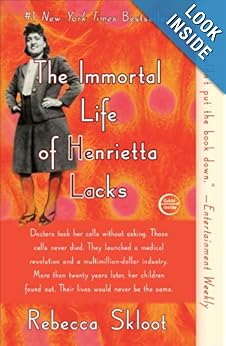
A few years ago I read such a book by science journalist Rebecca Skloot, The Immortal Life of Henrietta Lacks. It was fascinating, tragic and personal. As with any decent science book it made me think. I acquired a deeper knowledge of the history of genetic research and was swept into the realm of bioethics. When my son went to work in the lab at the Women's Research Hospital at Harvard I was able to have a surprisingly intelligent discussion with him about HeLa cells, their history and their place in science research today.

Mason tells us that "we can only cover a mere inch of the field of science, it is true; but the attitude of mind we get in our own little bit of work helps us to the understanding of what is being done elsewhere." This one living science book gave me a deeper understanding on one subject but opened my mind to other closely related topics

This week, I read the news headline with great interest: The National Institute of Health Brokers HeLa Genome Deal. The book had made such an impression on me that I could still recall the people involved and empathized with their motivation and celebrate their accomplishment.

Ms. Skloot, the author of the book, was interviewed afresh with her perspective on this unprecedented agreement:  August 9th CBC radio podcast . It was nice to hear her out loud voice as I felt I 'knew' her as I read her book.

A Mason education is a life. I read with my children for years and I continue to read for myself. A book like The Immortal Life Henrietta Lacks adds experience and knowledge to my life and I care to know more.

"The question is not how much does the youth know when he is finished with his education - but how much does he care? and about how any orders of things does he care?" Charlotte Mason

all quotes from: https://amblesideonline.org/CM/toc.html#6

Saturday, 10 August 2013

The Ten Step Nature Walk

Literally. Ten steps. 
I did not have to pack my nature notebook. I did not fill my water bottle. 
I did not need to find my keys or the energy for the journey to a place where I can see God's creatures.

great golden digger wasp


I took ten steps out my back door to where my pond, 
overgrown with water lilies and filled with frogs, stands.
 Every year I tear mounds of  the invasive hydrilla out of the water
 and pull up tons of mint that throws runners over everything.

mud dauber wasp


But the mint that does grow back blooms and when it blooms,
everyone wants some.
Yesterday I took ten steps from my house, stood still 
and watched nature come to me.

metallic green bee 'Agapostemon'
cabbage white
carpenter bee
Nine different species that were kind enough to pose for a photo. 
And this was not even looking in the pond or counting what landed on the other plants.    I stood there for a good thirty minutes hardly noticing the heat of the unclouded sun.    I did notice it when my shadow obscured my view and disturbed 
an insect.
Plant something that brings nature to your door step. 
Or at least within ten steps of it.